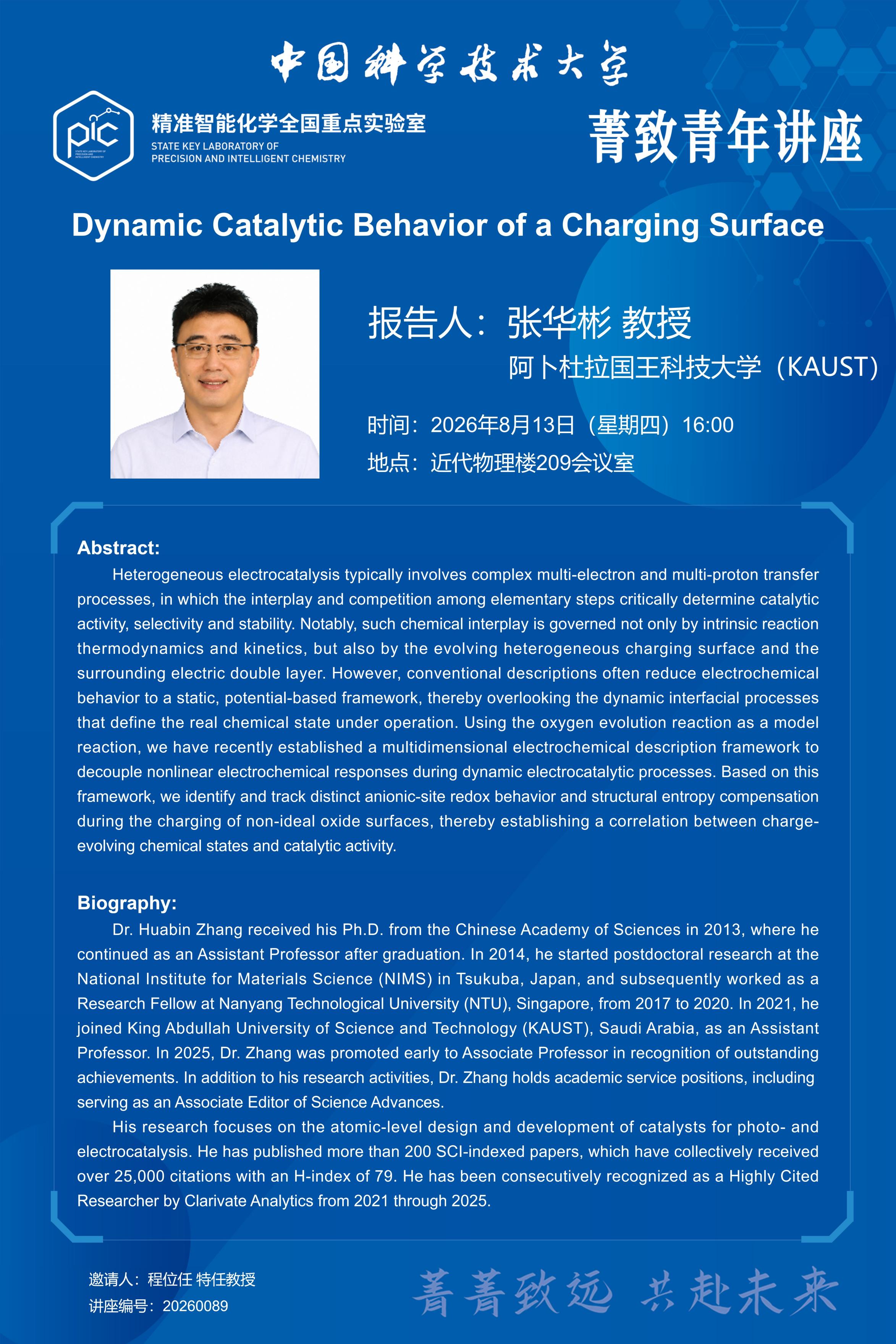
报告摘要 | Heterogeneous electrocatalysis typically involves complex multi-electron and multi-proton transfer processes, in which the interplay and competition among elementary steps critically determine catalytic activity, selectivity and stability. Notably, such chemical interplay is governed not only by intrinsic reaction thermodynamics and kinetics, but also by the evolving heterogeneous charging surface and the surrounding electric double layer. However, conventional descriptions often reduce electrochemical behavior to a static, potential-based framework, thereby overlooking the dynamic interfacial processes that define the real chemical state under operation. Using the oxygen evolution reaction as a model reaction, we have recently established a multidimensional electrochemical description framework to decouple nonlinear electrochemical responses during dynamic electrocatalytic processes. Based on this framework, we identify and track distinct anionic-site redox behavior and structural entropy compensation during the charging of non-ideal oxide surfaces, thereby establishing a correlation between charge-evolving chemical states and catalytic activity. |
报告人简介 | Dr. Huabin Zhang received his Ph.D. from the Chinese Academy of Sciences in 2013, where he continued as an Assistant Professor after graduation. In 2014, he started postdoctoral research at the National Institute for Materials Science (NIMS) in Tsukuba, Japan, and subsequently worked as a Research Fellow at Nanyang Technological University (NTU), Singapore, from 2017 to 2020. In 2021, he joined King Abdullah University of Science and Technology (KAUST), Saudi Arabia, as an Assistant Professor. In 2025, Dr. Zhang was promoted early to Associate Professor in recognition of outstanding achievements. In addition to his research activities, Dr. Zhang holds academic service positions, including serving as an Associate Editor of Science Advances. His research focuses on the atomic-level design and development of catalysts for photo- and electrocatalysis. He has published more than 200 SCI-indexed papers, which have collectively received over 25,000 citations with an H-index of 79. He has been consecutively recognized as a Highly Cited Researcher by Clarivate Analytics from 2021 through 2025. |