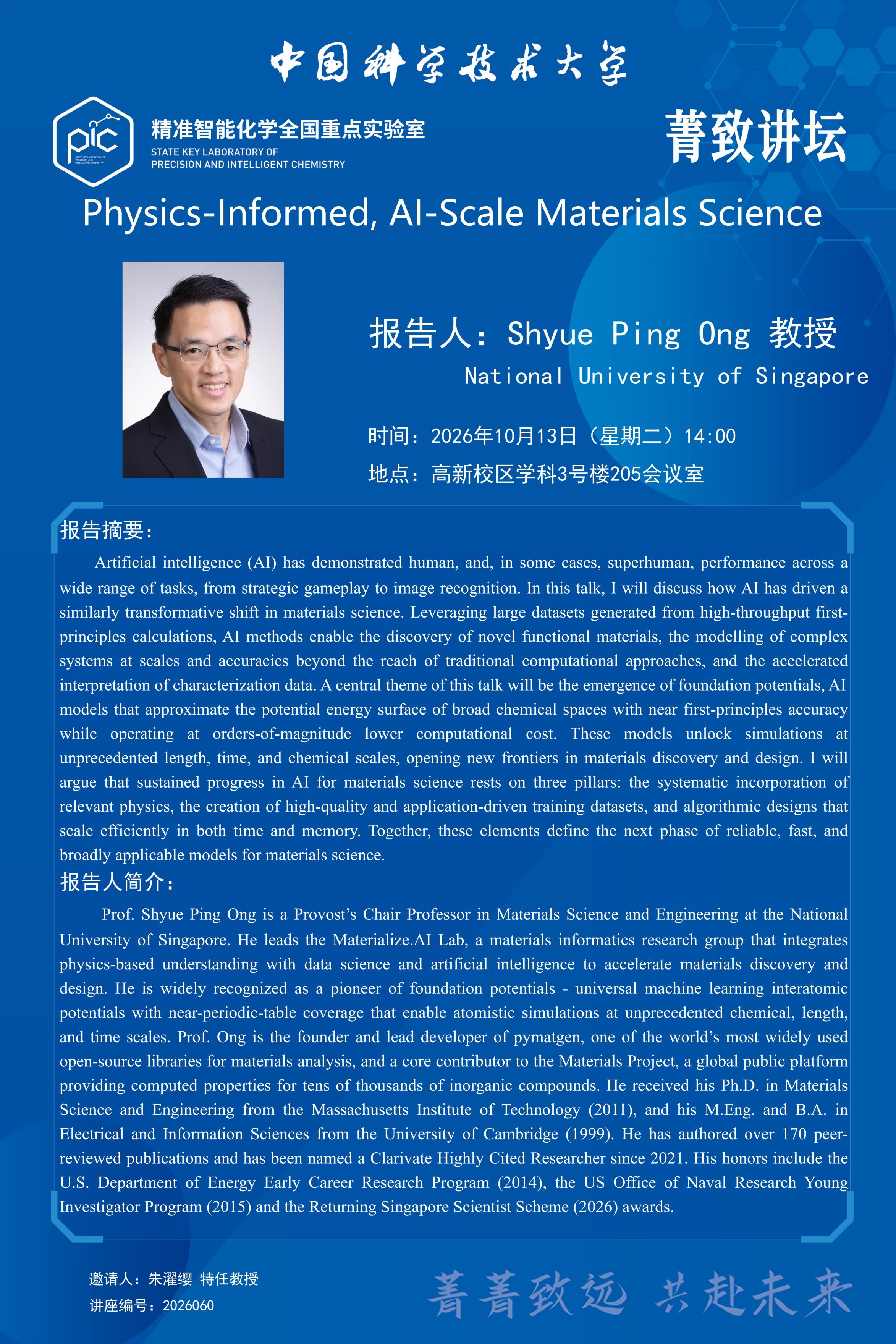
报告摘要 | Artificial intelligence (AI) has demonstrated human, and, in some cases, superhuman, performance across a wide range of tasks, from strategic gameplay to image recognition. In this talk, I will discuss how AI has driven a similarly transformative shift in materials science. Leveraging large datasets generated from high-throughput first-principles calculations, AI methods enable the discovery of novel functional materials, the modelling of complex systems at scales and accuracies beyond the reach of traditional computational approaches, and the accelerated interpretation of characterization data. A central theme of this talk will be the emergence of foundation potentials, AI models that approximate the potential energy surface of broad chemical spaces with near first-principles accuracy while operating at orders-of-magnitude lower computational cost. These models unlock simulations at unprecedented length, time, and chemical scales, opening new frontiers in materials discovery and design. I will argue that sustained progress in AI for materials science rests on three pillars: the systematic incorporation of relevant physics, the creation of high-quality and application-driven training datasets, and algorithmic designs that scale efficiently in both time and memory. Together, these elements define the next phase of reliable, fast, and broadly applicable models for materials science. |
报告人简介 | Prof. Shyue Ping Ong is a Provost’s Chair Professor in Materials Science and Engineering at the National University of Singapore. He leads the Materialize.AI Lab, a materials informatics research group that integrates physics-based understanding with data science and artificial intelligence to accelerate materials discovery and design. He is widely recognized as a pioneer of foundation potentials - universal machine learning interatomic potentials with near-periodic-table coverage that enable atomistic simulations at unprecedented chemical, length, and time scales. Prof. Ong is the founder and lead developer of pymatgen, one of the world’s most widely used open-source libraries for materials analysis, and a core contributor to the Materials Project, a global public platform providing computed properties for tens of thousands of inorganic compounds. He received his Ph.D. in Materials Science and Engineering from the Massachusetts Institute of Technology (2011), and his M.Eng. and B.A. in Electrical and Information Sciences from the University of Cambridge (1999). He has authored over 170 peer-reviewed publications and has been named a Clarivate Highly Cited Researcher since 2021. His honors include the U.S. Department of Energy Early Career Research Program (2014), the US Office of Naval Research Young Investigator Program (2015) and the Returning Singapore Scientist Scheme (2026) awards. |