
报告题目 | X-ray scattering methods for in situ and operando studies of electrocatalysts |
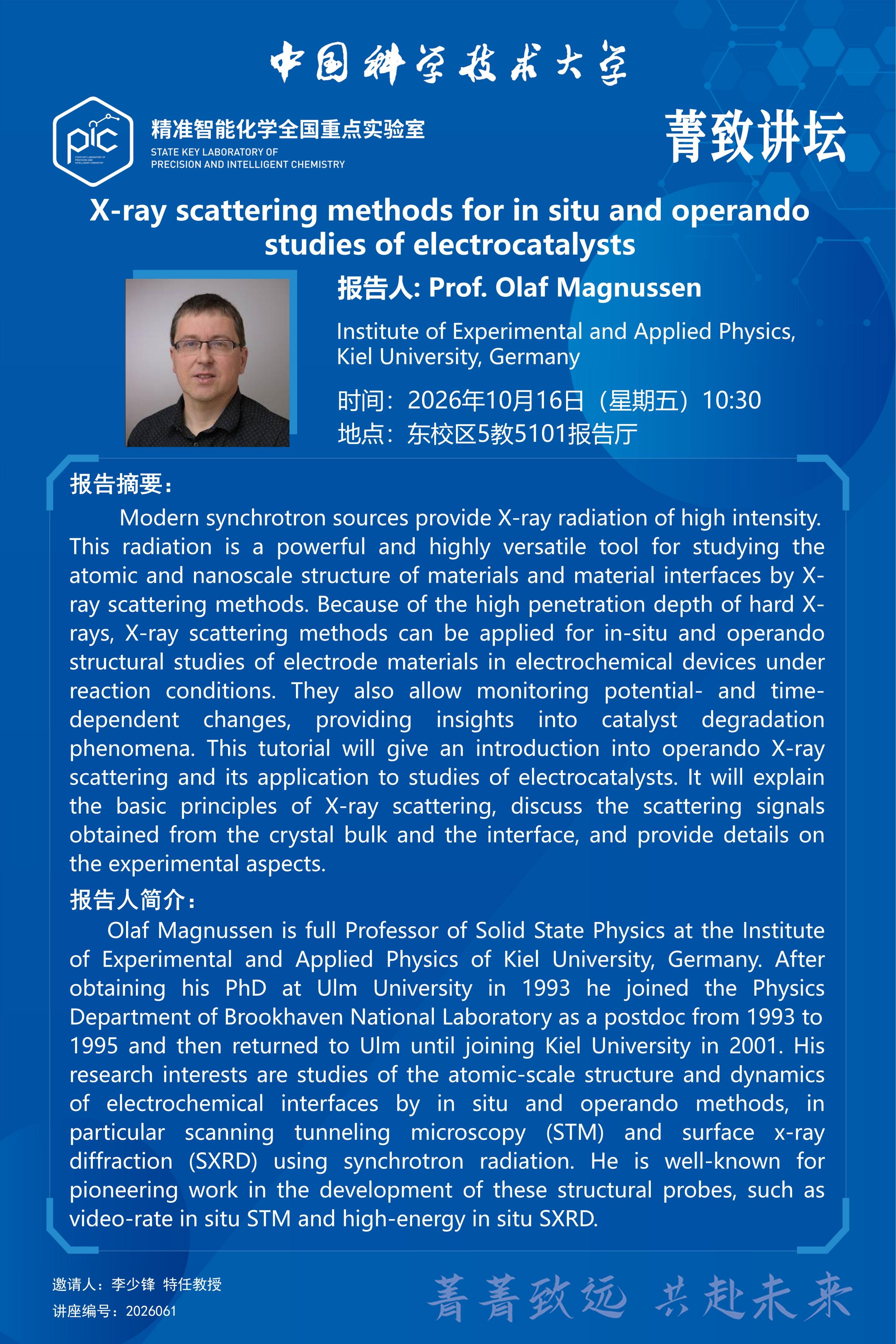
报告人 | Prof. Olaf Magnussen |
报告人单位 | Institute of Experimental and Applied Physics, Kiel University, Germany |
报告时间 | 2026年10月16日(星期五)10:30 |
报告地点 | 东校区5教5101报告厅 |
主办单位 | 精准智能化学全国重点实验室 |
报告摘要 | Modern synchrotron sources provide X-ray radiation of high intensity. This radiation is a powerful and highly versatile tool for studying the atomic and nanoscale structure of materials and material interfaces by X-ray scattering methods. Because of the high penetration depth of hard X-rays, X-ray scattering methods can be applied for in-situ and operando structural studies of electrode materials in electrochemical devices under reaction conditions. They also allow monitoring potential- and time-dependent changes, providing insights into catalyst degradation phenomena. This tutorial will give an introduction into operando X-ray scattering and its application to studies of electrocatalysts. It will explain the basic principles of X-ray scattering, discuss the scattering signals obtained from the crystal bulk and the interface, and provide details on the experimental aspects. |
报告人简介 | Olaf Magnussen is full Professor of Solid State Physics at the Institute of Experimental and Applied Physics of Kiel University, Germany. After obtaining his PhD at Ulm University in 1993 he joined the Physics Department of Brookhaven National Laboratory as a postdoc from 1993 to 1995 and then returned to Ulm until joining Kiel University in 2001. His research interests are studies of the atomic-scale structure and dynamics of electrochemical interfaces by in situ and operando methods, in particular scanning tunneling microscopy (STM) and surface x-ray diffraction (SXRD) using synchrotron radiation. He is well-known for pioneering work in the development of these structural probes, such as video-rate in situ STM and high-energy in situ SXRD. |
文稿:戴玉飞
审发:项启瑞